
A strong core is about far more than visible abs—it’s the foundation for how you move, lift, run, and live without pain. This guide goes beyond surface-level workouts to give you a complete, practical plan for building real strength from the inside out. Many people waste time on ineffective routines that lead to plateaus, back discomfort, and poor performance. Here, you’ll focus on proven functional movements and core stability workouts that build resilience, balance, and power. You’ll learn exactly which exercises to do, how to perform them correctly, and how to progress safely from beginner to advanced.
Understanding Your True Core: The Foundation of All Movement
Incorporating core stability workouts into your fitness routine is not only essential for building a strong foundation for overall physical performance but can also complement healthy lifestyle habits that contribute to longevity, as discussed in our article on longevity research – for more details, check out our Longevity Research: Habits Linked to a Longer Life.
First things first: your “core” isn’t just the six-pack muscle (that’s the rectus abdominis). It’s a 3D support system made up of the abdominals, obliques, lower back, glutes, and even the diaphragm—the breathing muscle that quietly does its job like an underrated sidekick. In other words, it’s less “mirror muscle” and more “mission control.”
So why does that matter? Because a strong core stabilizes your spine, transfers force between your upper and lower body, and helps prevent injuries when you lift groceries, twist to grab your seatbelt, or bend to tie your shoes (yes, that counts as athletic activity). Without it, movement leaks energy—like trying to fire a cannon from a canoe.
Before any exercise, practice bracing—gently tightening the deep transverse abdominis as if preparing for a playful poke. That mind-muscle connection turns basic moves into effective core stability workouts and keeps your foundation rock solid.
Foundational Core Exercises for Absolute Beginners
When people hear “core”, they often think six-pack abs. In reality, your core includes all the muscles around your trunk—abdominals, obliques, lower back, and even glutes. Think of it as your body’s stability system (like the frame of a house). These beginner-friendly core stability workouts focus on control, not speed.
The Plank
- Start on your forearms and toes.
- Create a straight line from head to heels.
- Squeeze your glutes and brace your abs (brace means tightening as if preparing for a gentle punch).
- Hold for 3 sets of 30 seconds.
Common mistakes include sagging hips or lifting your hips too high. If you look like a mountain instead of a table, reset.
Bird-Dog
This builds cross-body stability, meaning opposite sides of your body work together.
- Begin on hands and knees.
- Extend your right arm and left leg.
- Keep your torso perfectly still.
- Return and switch sides.
If your hips twist, you’ve gone too far (slow and steady wins here).
Glute Bridge
This activates the posterior chain—the muscles along the back of your body.
- Lie on your back, knees bent.
- Press through your heels and lift your hips.
- Squeeze your glutes at the top.
Avoid arching your lower back; the movement should come from your hips.
Dead Bug
Despite the funny name, this move teaches coordination.
- Lie on your back, arms and legs raised.
- Press your lower back into the floor.
- Lower opposite arm and leg slowly.
If your back lifts, reset. Control always comes first.
Intermediate Movements to Build Functional Strength
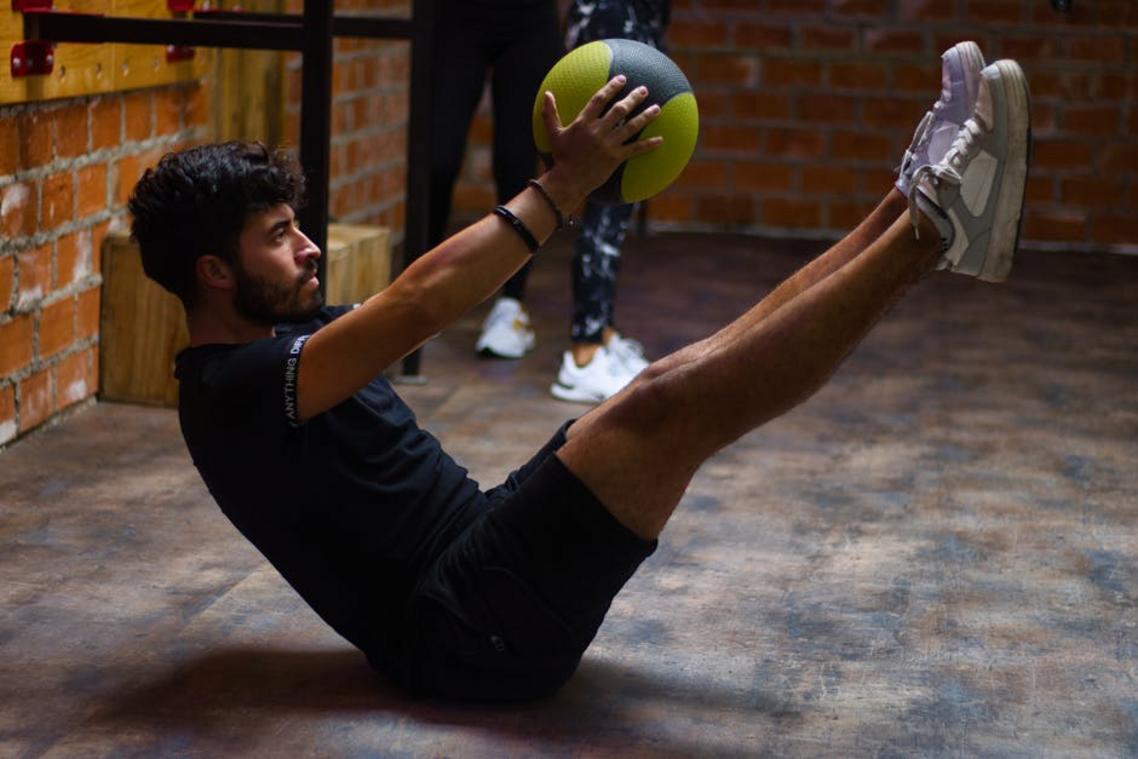
Once you’ve mastered the basics, it’s time to introduce dynamic movement and increased resistance. This is where strength starts to feel athletic—not just aesthetic. In my opinion, this is the phase where workouts stop feeling like rehab and start feeling like preparation for real life.
Hollow Body Hold
Think of this as the upgraded Dead Bug. Lie on your back and press your lower spine into the floor. Lift your shoulders and legs slightly to form a curved “dish” shape—arms overhead, ribs tucked, glutes tight. That full-body tension is the point. You’re teaching your core to resist extension (meaning it prevents your lower back from arching). If your back peels off the ground, regress. Quality beats ego every time.
Side Plank with Hip Dip
From a side plank, slowly lower your hips a few inches toward the floor, then lift back up under control. The controlled dip challenges the obliques (side abdominal muscles) and lateral stability. It’s subtle—but brutal. I like this better than endless crunches because it actually trains how your body stabilizes when you shift weight (like carrying groceries on one side).
Farmer’s Walks
Pick up a dumbbell or kettlebell in one or both hands. Stand tall. Walk slowly. That’s it. Sounds simple, but it builds grip strength, posture, and total-body stability. Real-world benefit? Carrying luggage without folding like a lawn chair. Pro tip: keep your ribs stacked over your hips.
Pallof Press
Attach a band at chest height. Press it straight out without letting your torso rotate. This anti-rotation drill builds the stability behind powerful swings and throws. It’s a staple in smart core stability workouts.
If you skipped the basics, revisit this beginner strength training plan for building a solid base first. Foundation matters.
Advanced core work humbled me fast. The first time I tried hanging leg raises, my grip gave out before my abs did (turns out, forearms matter).
Hanging Leg Raises
Knee tucks bend the knees, shorten the lever, and reduce torque (rotational force) on the hips—ideal if you’re building baseline strength. Straight-leg raises lengthen the lever, increasing demand on the rectus abdominis and hip flexors. Pro tip: pause at 90 degrees to kill momentum.
Ab Rollout
Using a wheel or loaded barbell, you extend into near-horizontal while resisting lumbar extension—aka preventing your lower back from arching. Extreme bracing is non‑negotiable; think “ribs down.” I once overextended and felt my spine complain for days.
Turkish Get-Up
This full-body integration drill progresses from:
• Roll to elbow
• Post to hand
• High bridge sweep
Each step layers stability, making it a cornerstone of serious core stability workouts. Master patience before adding load.
A strong, functional core isn’t built through intensity alone—it’s built through consistency. If you’ve been overlooking your midsection, you may already feel the effects: nagging back discomfort, stalled progress, or a lack of overall strength and balance. A weak core is a weak foundation.
The fix doesn’t require hours in the gym. Adding 2–3 core stability workouts into your weekly routine can dramatically improve performance, posture, and long-term resilience. Small, focused effort repeated consistently is what creates real change.
Build Your Foundation the Right Way
Start with foundational movements, master your form, and gradually progress as your strength improves. Don’t wait for pain or plateaus to force a reset. Take control now—commit to consistent core stability workouts this week and build the strong, injury-resistant foundation your body needs.
 Ask Kenneth Weldoneverico how they got into wellness buzz and you'll probably get a longer answer than you expected. The short version: Kenneth started doing it, got genuinely hooked, and at some point realized they had accumulated enough hard-won knowledge that it would be a waste not to share it. So they started writing.
What makes Kenneth worth reading is that they skips the obvious stuff. Nobody needs another surface-level take on Wellness Buzz, In-Depth Wisdom, Healthy Living Hacks. What readers actually want is the nuance — the part that only becomes clear after you've made a few mistakes and figured out why. That's the territory Kenneth operates in. The writing is direct, occasionally blunt, and always built around what's actually true rather than what sounds good in an article. They has little patience for filler, which means they's pieces tend to be denser with real information than the average post on the same subject.
Kenneth doesn't write to impress anyone. They writes because they has things to say that they genuinely thinks people should hear. That motivation — basic as it sounds — produces something noticeably different from content written for clicks or word count. Readers pick up on it. The comments on Kenneth's work tend to reflect that.
Ask Kenneth Weldoneverico how they got into wellness buzz and you'll probably get a longer answer than you expected. The short version: Kenneth started doing it, got genuinely hooked, and at some point realized they had accumulated enough hard-won knowledge that it would be a waste not to share it. So they started writing.
What makes Kenneth worth reading is that they skips the obvious stuff. Nobody needs another surface-level take on Wellness Buzz, In-Depth Wisdom, Healthy Living Hacks. What readers actually want is the nuance — the part that only becomes clear after you've made a few mistakes and figured out why. That's the territory Kenneth operates in. The writing is direct, occasionally blunt, and always built around what's actually true rather than what sounds good in an article. They has little patience for filler, which means they's pieces tend to be denser with real information than the average post on the same subject.
Kenneth doesn't write to impress anyone. They writes because they has things to say that they genuinely thinks people should hear. That motivation — basic as it sounds — produces something noticeably different from content written for clicks or word count. Readers pick up on it. The comments on Kenneth's work tend to reflect that.